Lifespan23 years under human care
Quick facts


DietSilkwood leaves, fruits, cereals, flowers and grass
HabitatDense tropical rainforests
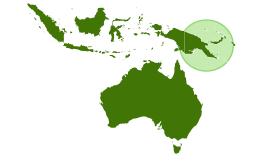
RangePapua New Guinea
The tree kangaroos

Back up the trees
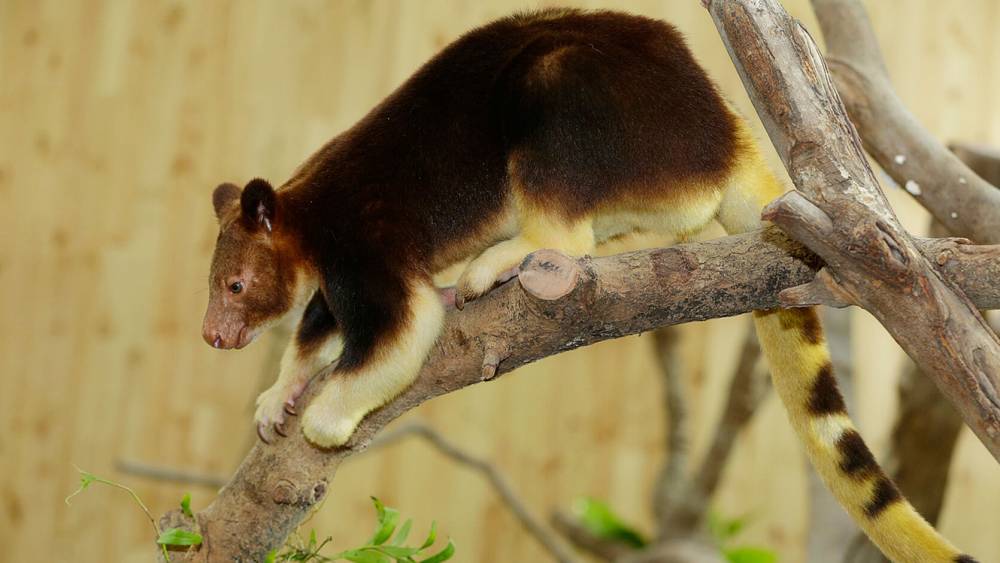
A long time ago, kangaroos evolved from tree-dwelling marsupials, developing adaptations for living on the ground. Tree kangaroos broke off from their land cousins by going back to arboreal life.
Their forelimbs grew muscular, their feet broadened and their claws curved to help them climb. They usually take little hopping steps and are unable to move more than two "kangaroo hops" at a go. However, they can leap up to 15m from tree to ground and can even walk backwards!
Pouch protection
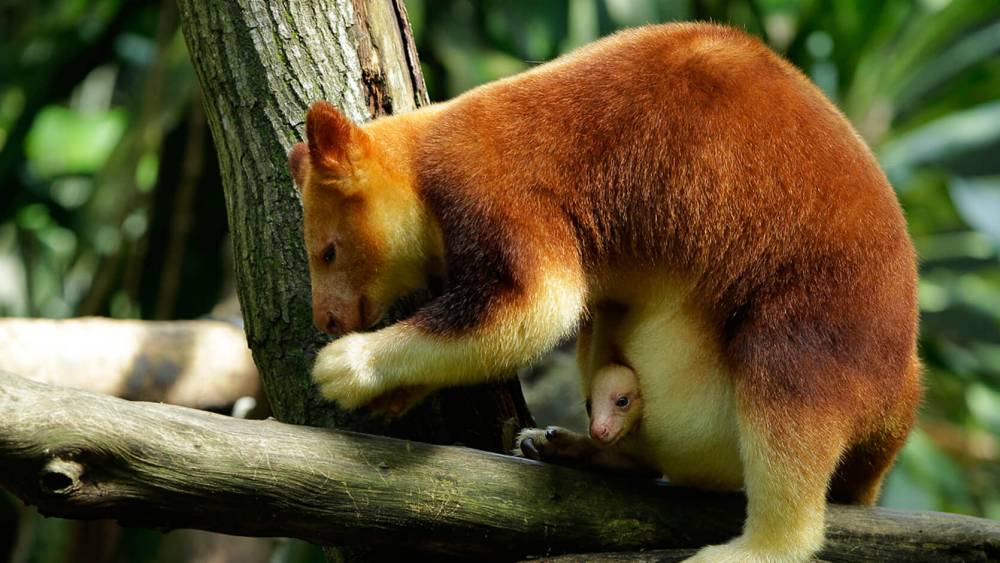
Females have a forward-opening pouch with four teats. After a pregnancy of 21 – 38 days, a mother prepares for the arrival of her baby roo by giving her pouch a thorough lick.
Her newborn — the size of a jellybean — climbs into the safety of her pouch all by itself and clamps onto one of the teats. That’s where it stays and grows for the next 10 – 12 months.
A joey that’s left the pouch will still return frequently for months to nurse, but only from its ‘own’ teat.
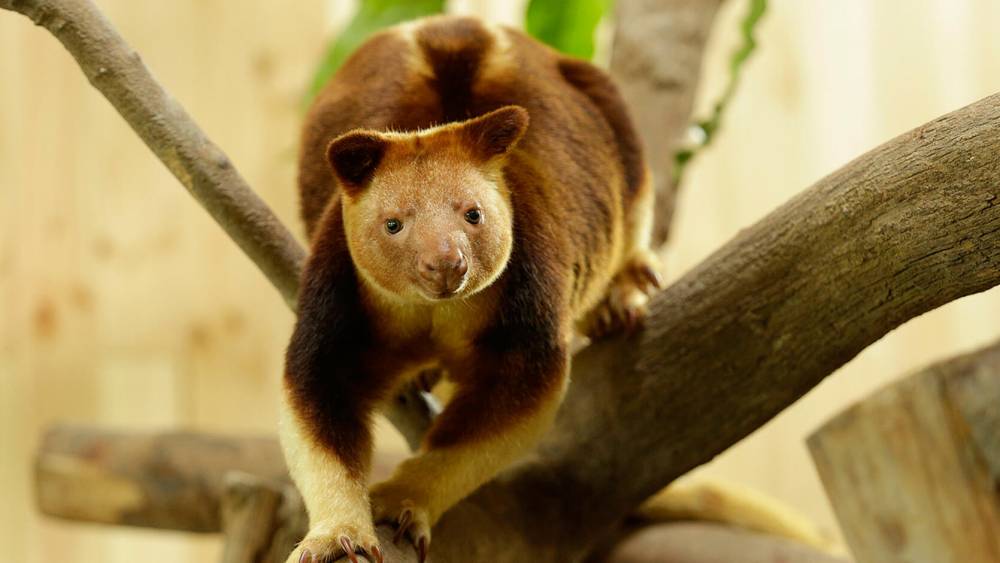
The kangaroo that lives on trees
Meet Makaia, the miracle kangaroo.
Makaia means “magic” in Tok Pisin, a Papua New Guinean language. When he was but 47 days old, Makaia was orphaned. To save his life, his keepers at Adelaide Zoo placed him in the pouch of a yellow-footed rock wallaby. The cross-fostering was a world first and made news globally.
When Makaia outgrew his foster mum’s pouch at three-and-a-half months, he was hand-raised by his keeper. He’s the only tree kangaroo to have had three mummies!
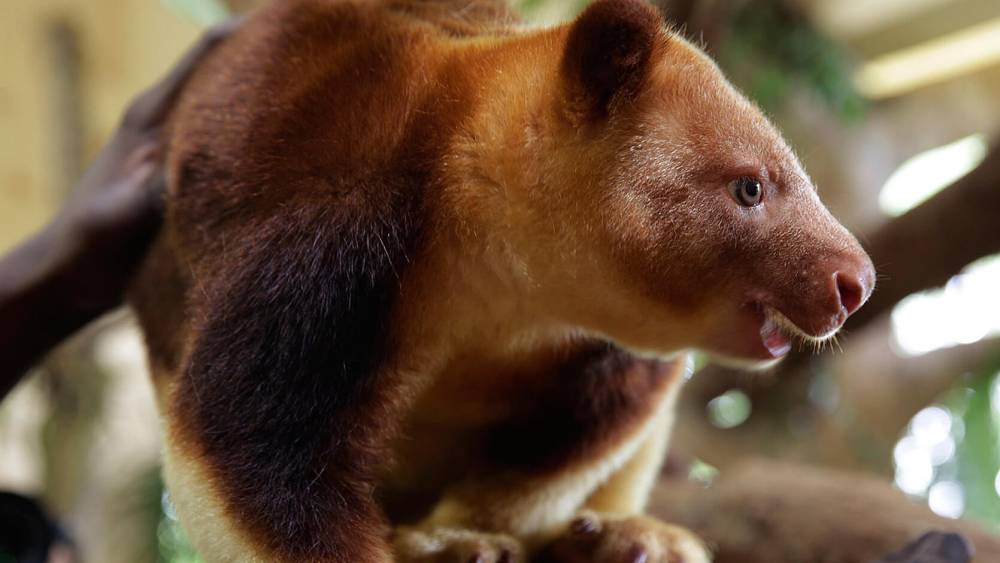
Gentle mummy’s boy
Makaia arrived with a teddy bear in tow — a gift from his keepers in Australia for company on the long trip. Rather timid at first, he’d climb up high to survey his surroundings from vantage points. He’s since settled in well.
Unlike most animals that feed with their mouth when handfed, Makaia receives food with his forepaw before popping it in his mouth — quite the gentleman!
As for the teddy, Makaia’s said bye to it. Even thunder and lightning faze him no longer!
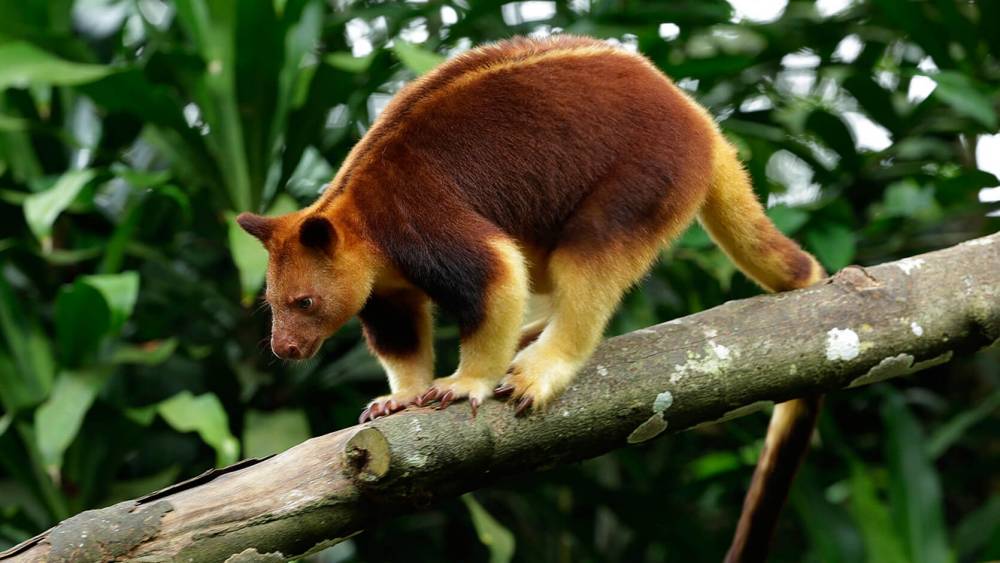
Match-made
Our 'mummy’s boy' is a big boy now and has now become a father himself.
The World Association of Zoos and Aquariums' (WAZA) Global Species Management Plan (GSMP) has “match-made” Makaia with Nupela, who hailed from Taronga Zoo.
The first Goodfellow’s tree kangaroo to be born there in over 20 years, Nupela also enjoyed ‘celebrity’ status back in Sydney. Like Makaia, she arrived here in 2016. It seems she’s something of a foodie too — a perfect fit for Singapore!
Together, we protect wildlife
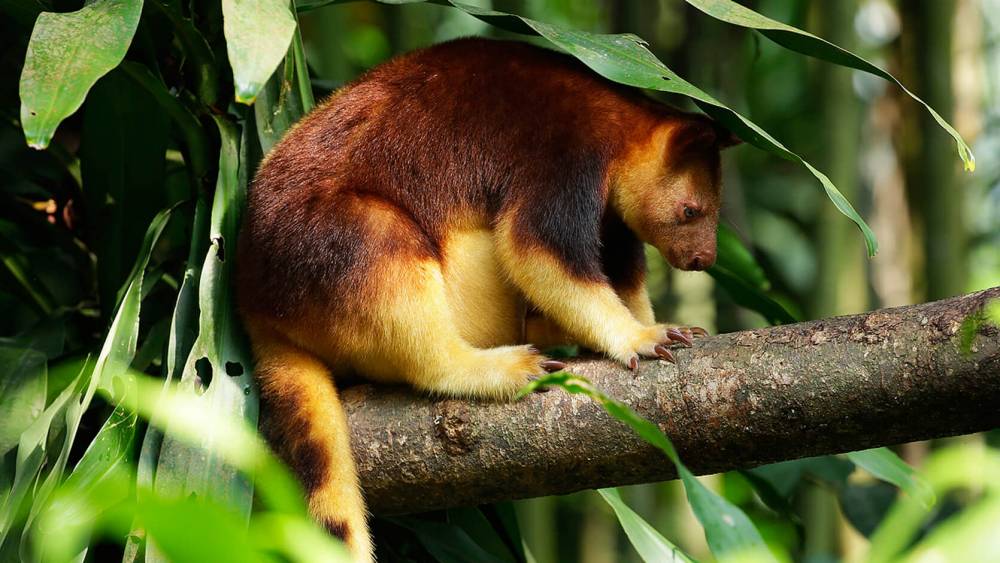
Halved in half a century
In the last 50 years, their wild population has gone down 50% due to hunting for food by locals and habitat loss to logging. There are only 50 individuals under human care globally. In 2012, a GSMP was set up by WAZA to ensure the survival of this species.
The IUCN Status
EN
Endangered
At very high risk of extinction in the wild
Managed breeding
Such programmes enable zoos from across countries and continents to coordinate the breeding of threatened species in a scientific manner. Demographic and genetic sustainability of the population is the goal. Various zoos in Australia, Europe, North America, Japan and Singapore are party to this GSMP.
The IUCN Status
EN
Endangered
At very high risk of extinction in the wild
Matchmade for conservation
The pairing of Makaia and Nupela is part of global efforts to save the species. We have seen success in our breeding efforts, and we have contributed to the GSMP by sending the offspring to zoos in Japan and France. By matchmaking suitable individuals from participating zoos, inbreeding is minimised and the global genetic pool under human care is enhanced.
The IUCN Status
EN
Endangered
At very high risk of extinction in the wild
Assurance populations
The population in zoos also acts as an assurance colony in the case of a catastrophic decline in the wild. Once the threats in the wild are mitigated, reintroduction of suitable individuals from the assurance colony will be explored. Together with conservation efforts in the animals’ natural habitats, these breeding programmes help to ensure their continued survival in the face of threats like hunting and habitat destruction.
The IUCN Status
EN
Endangered
At very high risk of extinction in the wild

The IUCN Red List of Threatened Species
The IUCN Red List of Threatened Species is widely recognized as the most comprehensive, objective global approach for evaluating the conservation status of plant and animal species.
DD
Data Deficient
Unknown risk of extinction
LC
Least Concern
At relatively low risk of extinction
NT
Near Threatened
Likely to become vulnerable in the near future
VU
Vulnerable
At high risk of extinction in the wild
EN
Endangered
At very high risk of extinction in the wild
CR
Critically Endangered
At extremely high risk of extinction in the wild
EW
Extinct in the Wild
Survives only in captivity
EX
Extinct
No surviving individuals in the wild or in captivity