Mandai Wildlife Group Baby Roundup 2025
Coinciding with the spirit of renewal leading up to the Lunar New Year, Mandai Wildlife Group is delighted to share a roundup of its newest arrivals, each one adding to the thriving, healthy animal families that visitors can discover across the wildlife parks.
Year in Numbers
- In 2025, Singapore’s five wildlife parks collectively welcomed about 1,000 babies across more than 150 species
- Around 50 species are listed as threatened under the International Union for the Conservation of Nature’s (IUCN) Red List of Threatened Species
- Over 30 species are part of internationally managed breeding programmes aimed at maintaining genetically healthy and sustainable populations of species in human care for the long-term while supporting conservation efforts in the wild
- Mandai Wildlife Group currently participates in over 200 of such programmes, including the European Association of Zoos and Aquaria (EAZA) Ex-situ Programme (EEP), and World Association of Zoos and Aquariums (WAZA) Global Species Management Plans (GSMP)
Overview
In 2025, Mandai Wildlife Group celebrated the birth of around a thousand animal babies across Singapore Zoo, Night Safari, River Wonders, Bird Paradise and Rainforest Wild ASIA. Among the new additions are the critically endangered red-shanked douc langur and Huulien leopard gecko, as well as the first successful Socorro dove hatchlings, a species that is extinct in the wild. Other first-time milestones include the L’hoest’s monkey, wattled crane and Chinese fire belly newt.
Dr Cheng Wen-Haur, Deputy CEO and Chief Life Sciences Officer, Mandai Wildlife Group, said, “2025 has been a remarkable year for Mandai Wildlife Group. From our first‑ever kagu and wattled crane chicks to endangered manatee calves and red dhole pups, each new arrival is a proud moment for the teams who care for them and reflects our commitment to raising healthy, thriving wildlife in our zoological institutions. We are excited to share these successes with our visitors as well as sponsors and partners, whose continued support allows us to keep moving forward with our mission.”
Ring in the Lunar New Year with a meaningful family outing to the Mandai Wildlife Reserve, where each visit contributes to the care and protection of the wildlife that call the parks home.
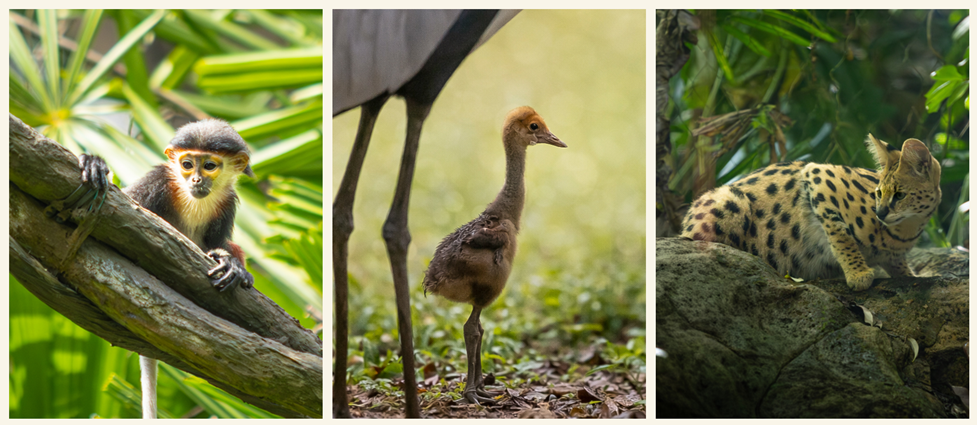
Image 1 (above left): Singapore Zoo rang in the new year with a male red-shanked douc langur born on 1 January 2025. Infants have a dark-coloured face which lightens as they grow.
Photo credit: Mandai Wildlife Group
Image 2 (above middle): Mandai Wildlife Group’s first wattled crane chick, one of several first-time hatchlings from threatened species at Bird Paradise last year.
Photo credit: Mandai Wildlife Group
Image 3 (above right): The male serval kitten (pictured) at Singapore Zoo is shy and likes to stay close to mum, while his sister is more independent.
Photo credit: Mandai Wildlife Group
Highlights
| Singapore Zoo | |
|---|---|
| Serval | Singapore Zoo welcomed its first serval kittens in 12 years when Lyla, who arrived from Rotterdam Zoo in 2023, gave birth to a healthy male and female on 25 June 2025. Now exploring the Great Rift Valley of Ethiopia with their mother, the kittens are beginning to reveal their personalities — the male staying close to Lyla while his bolder sister ventures further afield. Their arrival brings renewed energy to the habitat and offers guests a rare chance to see these sleek, long‑legged African cats growing up. |
| Grevy’s zebra | As the largest of all zebra species, Grevy’s zebras are known for their elegant, narrow stripes, and Singapore Zoo’s latest foal embodies these signature traits perfectly. Born on 2 December 2025 to Desta and Moyo, she is already charming keepers with her curious habit of stopping mid‑stride to observe her surroundings before trotting after her mum at Wild Africa. Her arrival is especially meaningful as Grevy’s zebras are endangered, and sustaining their numbers under human care is vital to the species’ long‑term future. |
Primates
|
The primate family at Singapore Zoo also grew this year with the births of a red‑shanked douc langur, a L’hoest’s monkey and twin red‑ruffed lemurs. Nhat, the young red‑shanked douc born on 1 January 2025, is already a cheeky favourite, often darting between older siblings to steal mulberry leaves. The zoo’s first L’hoest’s monkey infant, born on 28 June, is equally charming — bold enough to wander from mum Koumi, yet quick to be scooped back into her arms. The year ended on a high note with twin red‑ruffed lemurs born on 13 December, cared for confidently by experienced mother Minnie. Guests can spot Nhat and the young L’hoest’s monkey at Primate Kingdom, while the red-ruffed lemurs will be making their debut soon. The lively youngsters each represent a boost for managed populations of these threatened species. |
Reptiles
|
2025 proved to be a standout year for RepTopia, with the first hatchings of two New Caledonia giant geckos, two Huulien leopard geckos and four Chinese fire belly newts. These successes added to other notable younglings, including the Philippine crocodile and painted terrapin. Targeted refinements in husbandry by the animal care team played a key role in these achievements. Nectar was introduced to the diet of the New Caledonia giant geckos, while additional bark provided essential hiding spaces. Carefully regulated temperatures, humidity and lighting designed to mimic natural seasonal cycles supported the successful breeding of the Huulien leopard gecko and Chinese fire belly newt. As little is known about the critically endangered Huulien leopard gecko, these hatchlings offer valuable opportunities for research into the species’ reproductive biology. |
Amphibians
|
The animal care team also recorded consistent breeding success among the amphibians. Through a combination of simulating natural seasonal changes, fine-tuning water parameters and providing suitable egg-laying sites, the team has successfully bred the Vietnamese mossy frog and endangered golden mantella. Hatch counts reached 14 for the mossy frogs and 24 for the golden mantellas, reflecting the team’s growing expertise in amphibian breeding and managed care. |
| Night Safari | |
|---|---|
| Red dhole | Night Safari celebrated its first red dhole litter in almost a decade with the birth of three pups in June 2025. Raised under the devoted care of their mother Lalu — with dad bringing food and keeping a watchful eye — the pups were monitored unobtrusively through CCTV to ensure they developed well. Now more adventurous at six months old, the young dholes offer visitors the rare chance to observe this endangered Asian wild dog as a growing family along the tram route. |
Herbivores
|
The seladang herd also welcomed a male calf in June, which has since settled into its habitat. Its mother has been gently guiding the calf around the exhibit as it explores its new surroundings. The young bovine is responding well to auditory and sensory enrichment that helps keep the herd mentally and physically engaged. Several new fawns from threatened deer species have joined Night Safari’s growing ungulate herds, including four barasinghas, two thamins and a hog deer. These young deer are already venturing through their free-ranging habitats along the tram route and are especially curious during feeding times. To encourage natural foraging and grazing behaviour, keepers scatter chopped apples and carrots among dried leaves throughout their habitats. |
| River Wonders | |
|---|---|
| West Indian manatee | River Wonders continued to see new generations of West Indian manatees with two females born to Indy and Leandra on 3 October and 21 November 2025. The first-born calf arrived prematurely and was weak, requiring round-the-clock care from aquarists in a private off-exhibit area. Her team closely monitored her health and assisted with her breathing. She has started to taste solid food and is now exploring the Amazon Flooded Forest exhibit. The younger calf also received special care from the aquarists as first-time mum, Leandra, faced challenges with nursing. The baby has recently started suckling and is expected to wean off formula milk soon. |
| Boeseman’s rainbowfish | River Wonders’ breeding programme for the endangered Boeseman’s rainbowfish continued successfully in 2025, with over 60 fry born throughout the year. Aquarists supported breeding efforts by providing yarn spawning mops for egg-laying, then carefully transferring fertile eggs to a separate environment to hatch. |
| Bird Paradise | |
|---|---|
First-time hatches
|
In a year of firsts for Mandai Wildlife Group, Bird Paradise celebrated the successful hatching of its first wattled crane chick in November 2025, a vulnerable species native to the wetlands of Africa. Keepers at Rwanda Nyungwe Forest Heart of Africa were pleasantly surprised by the hatch, as the pair’s first egg just months earlier had been infertile. The three-month-old chick, weighing just over 2kg, is closely bonded to its mother. Wattled cranes are the second-largest crane species in the world, with adults typically weighing 6 to 9kg. To increase nutrition for the chick, keepers added supplements to the family’s mixed diet of soaked pellets, boiled vegetables, hard-boiled eggs and live insects, which the parents gathered to feed their growing chick. Two Socorro dove chicks hatched in August and September, marking the park’s first success with this extinct-in-the-wild species. Fewer than 200 individuals remain in human care in zoos globally. Both chicks have fully fledged and now reside in Winged Sanctuary, a zone dedicated to birds of high conservation value. The parents arrived at Bird Paradise in 2025 under the EEP. Bird Paradise welcomed its first kagu chicks in 2025, placing Mandai Wildlife Group among the few zoological institutions worldwide to have successfully hatched this endangered species. The older fledgling, Kiara, has settled into his aviary at Winged Sanctuary, while the younger chick, which hatched in November 2025, is being raised at the Breeding and Research Centre (BRC). Its daily care includes hand-feeding and supervised sun sessions to ensure adequate vitamin D for growth. |
Flamingos
|
Seven American flamingos and 15 greater flamingos were also hand-raised at the BRC to maximise their chances of survival. To support their development, the young flock followed a carefully managed routine that included daily pool time to develop strength and short walks to help acclimatise them to outdoor environments — often a lively affair as the curious chicks would wander away in different directions. Once fully weaned, they will join the adult flocks in Hong Leong Foundation Crimson Wetlands and Rwanda Nyungwe Forest Heart of Africa. |
| Gentoo penguin | Gentoo penguins, Riki and Peach, welcomed their third chick in two years, delighting keepers and visitors alike at Ocean Network Express Penguin Cove. The attentive parents take turns to feed their fluffy hatchling, which has been growing in confidence and venturing out of its nest to explore. Riki and Peach arrived in 2023 from Toyohashi Zoo & Botanical Park as part of the EAZA breeding programme for Gentoo penguins. |
| Rainforest Wild ASIA | |
|---|---|
| Philippine spotted deer | Rainforest Wild ASIA celebrated its first animal birth in February 2025, just a month before the park opened, when a male Philippine spotted deer fawn was born. The first-time parents arrived in Singapore from Zoo Landau, Germany, in June 2024. Also called the Visayan spotted deer, the Philippine spotted deer is one of the world’s most endangered deer species. Mandai Nature, Mandai Wildlife Group’s conservation arm, supports the conservation of the species in the Philippines through local partner, Talarak Foundation Inc. |
| Axis deer | Two new axis deer fawns also jointed the park’s herd in April 2025. The fawns are nearly fully grown and can often be seen grazing with their does in the park’s walk-through habitat, Forest Floor. |
| Southeast Asian box turtle | Rainforest Wild ASIA also welcomed a Southeast Asian box turtle hatchling, an endangered species found in Singapore and the region. Weighing just 10g at hatching, the juvenile has grown to over 700g under close care and monitoring. Adults of this species typically reach up to 2kg. |